

New Index by Global Citizen Solutions finds Tax Structure, not Headline Rate, Influences Where Global Citizens Relocate

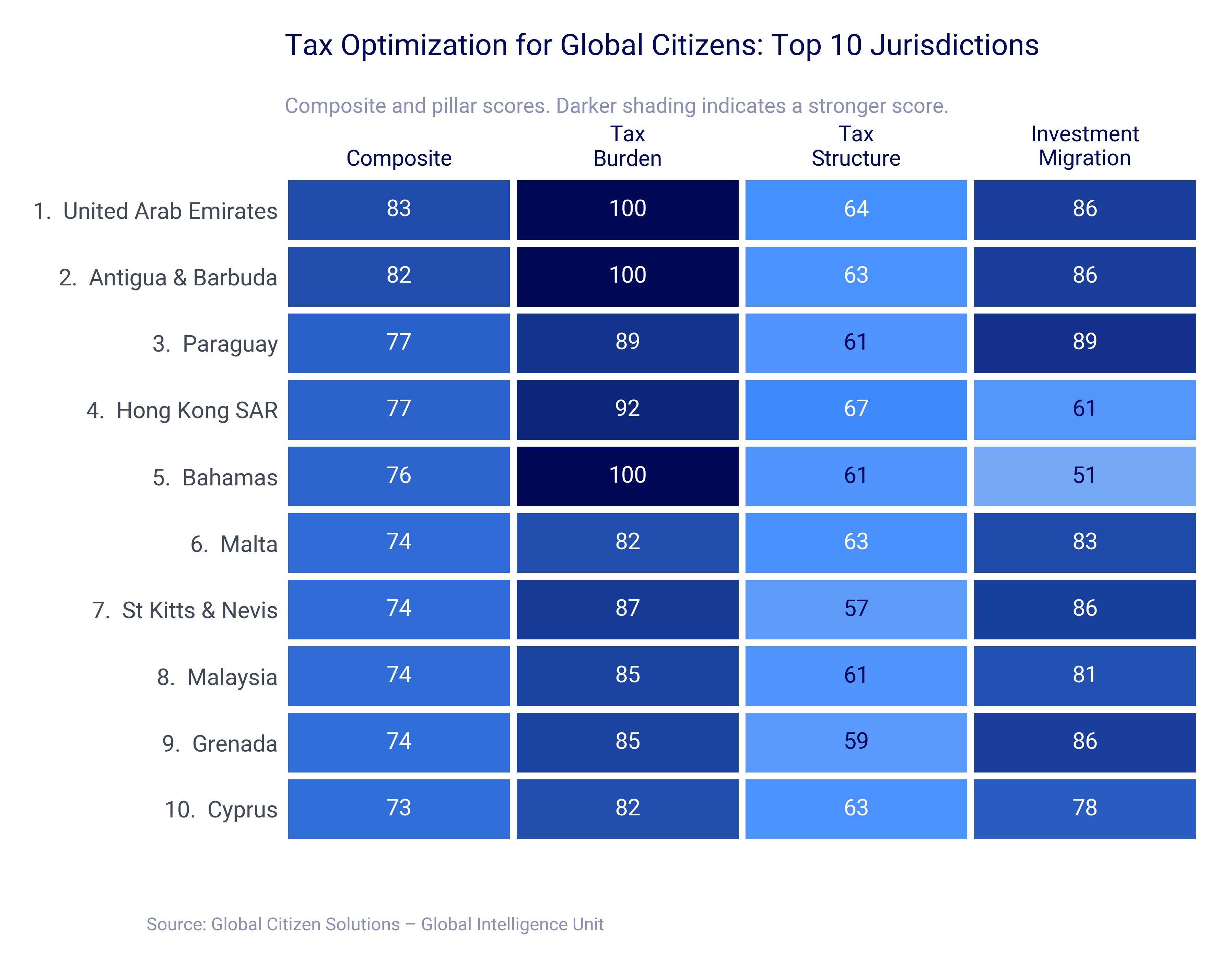
The UAE leads in favorable tax, followed by Antigua & Barbuda and Paraguay
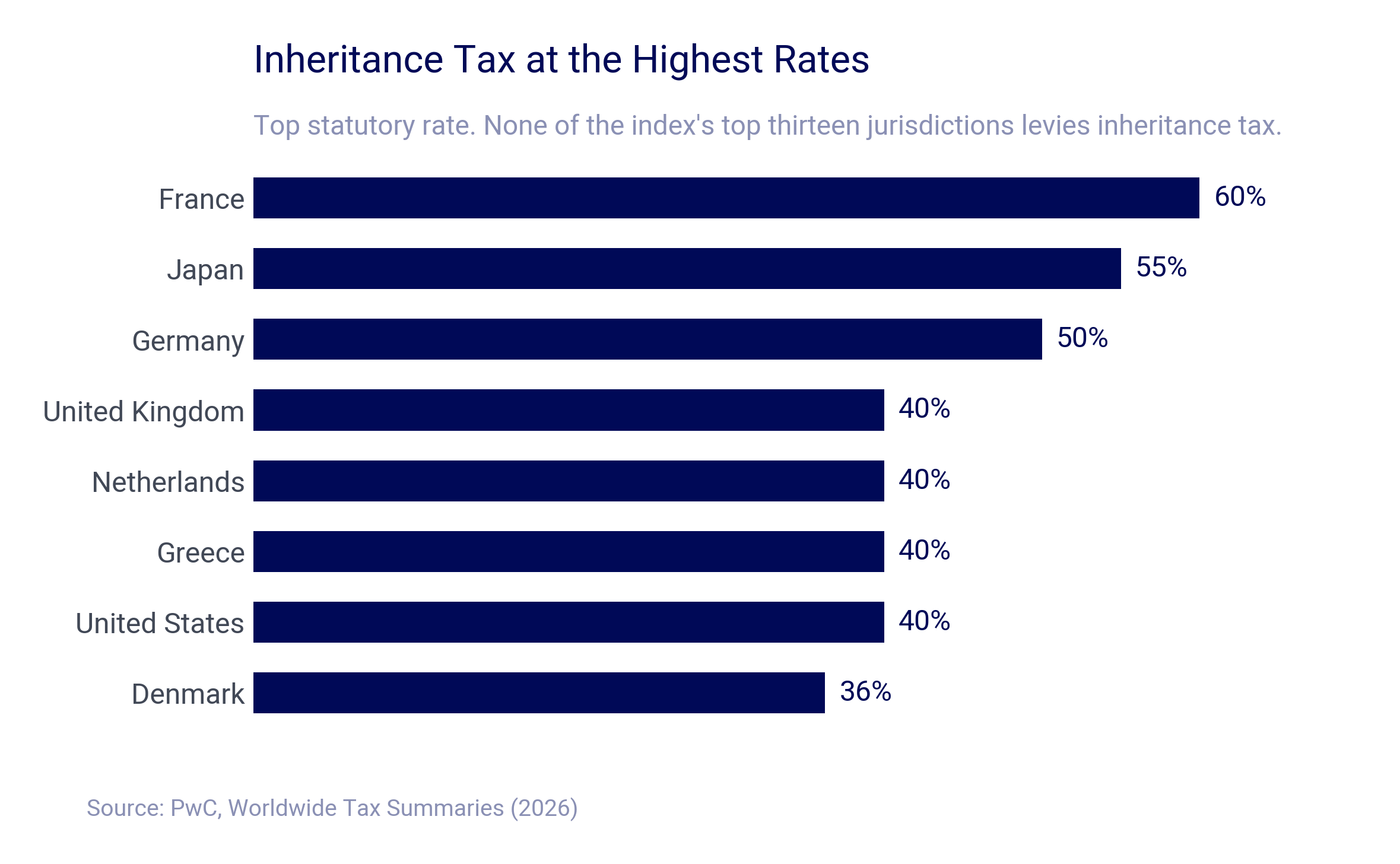
France leads the sample with the highest inheritance tax, followed by Japan, Germany, UK, Netherlands, Greece, USA and Denmark in 8th highest inheritance tax
New 48-jurisdiction index crowns the UAE as most favorable for tax, although seven places prove that tax and quality of life need not be enemies.
Global Citizen Solutions (GCS), the international residency and citizenship planning advisory firm, today published a new briefing developed by its research arm, the Global Intelligence Unit (“GIU”), entitled Tax Optimization for Global Citizens, a comparative study of tax positions across 48 jurisdictions for internationally mobile individuals. The briefing evaluates each jurisdiction across 11 indicators grouped into three pillars, Tax Burden, Tax Structure and Investment Migration, weighted at 42.5%, 42.5% and 15% respectively, on the premise that how a tax system treats foreign income and departing residents matters as much as the rate it charges.
The United Arab Emirates leads the overall ranking, pairing a zero rate of personal income tax with a 5% consumption tax and no charge on departure. Antigua & Barbuda, Paraguay, Hong Kong and the Bahamas complete the top five. Malta and Cyprus are the only two European jurisdictions to reach the top ten, doing so through preferential regimes rather than low headline rates.
Tax Structure Outweighs Headline Rates
The briefing's central finding is that a jurisdiction's tax rate and the structure of its tax system are largely independent of one another. Uruguay charges 36%, a rate closer to Western Europe than to the Caribbean yet records the strongest Tax Structure score of any jurisdiction in the sample, finishing twelfth overall on the strength of that structure alone. Hungary, by contrast, charges 15% but ranks 31st, because it charges its tax residents with worldwide income and offers arriving residents no substantial relief.
Two mechanisms explain a strong Tax Structure score: a taxation basis that never reaches foreign income, as in Uruguay, Panama and Hong Kong, or reaches it only on remittance, as in Malta and Mauritius; and a preferential regime layered over an otherwise worldwide system, as in Cyprus, Portugal and Italy.
"The countries that break the tax-versus-quality-of-life trade-off, Malta, Cyprus, Uruguay, Costa Rica, Mauritius, Switzerland, Portugal, don't get there through a zero-tax model. They perform well by taxing on a territorial or remittance basis, or through a well-designed preferential regime, which leaves room to fund the public services that quality of life depends upon. That's the real choice facing anyone relocating isn't simply about the lowest tax rate, but about how foreign income is treated — whether through automatic exemption, partial relief, or narrower carve-outs — and how much certainty that structure actually offers." — Artur Saraiva, Founder and COO, Global Citizen Solutions.
Living Well, Leaving Well
The briefing's two structural findings pull in opposite directions. Jurisdictions charging the least tax tend to rank lowest for quality of life, so what a resident saves in tax is measured against what they give up day to day. Thirty-one of the 48 jurisdictions in the study impose no exit tax at all, including every jurisdiction across Latin America and the Caribbean, so a lower cost of living rarely comes bundled with a lower cost of leaving, and a higher cost of living rarely buys an easier departure either. The United States carries the heaviest tax burden in the sample by rate and structure alike, and separately sets the most demanding exit terms of any jurisdiction reviewed.
Seven jurisdictions break the quality of life pattern by combining an upper-half tax position with a global top-fifty quality of life ranking: Malta, Cyprus, Uruguay, Costa Rica, Mauritius, Switzerland and Portugal. None achieves this by charging no income tax. Each instead uses a territorial, remittance or preferential-regime structure that leaves room to fund the public services that quality of life depends on. On exit, eleven of the seventeen jurisdictions that do charge on departure, among them Australia, Canada, Denmark, Germany, Norway, Spain and Switzerland, apply a broad charge with deferral available, while five, including Portugal, the UK and Japan, apply a narrower version. The United States sets the most demanding terms of any jurisdiction reviewed.
Death, Taxes and Exceptions
Inheritance tax separates high-burden systems from the leaders more sharply than any other measure in the index. France charges up to 60%, Japan 55% and Germany 50%, while none of the top thirteen jurisdictions in the index charges inheritance tax at all. The study also flags the United States as a distinct case: relocation alone does not end its tax reach.
Wealth tax, a Rare Breed
Net wealth tax applies in only eight of the 48 jurisdictions in the sample, at rates ranging from 0.1% in Uruguay to 3.5% in Spain. None of the jurisdictions charging no personal income tax also levies a wealth tax, so the absence of an income charge and the absence of a wealth charge tend to move together rather than trading off against one another.
The briefing concludes that no single jurisdiction suits every profile. Entrepreneurs approaching a liquidity event are governed by capital gains treatment and the cost of departure; retirees are governed by succession, healthcare and consumption tax; and remote professionals are governed almost entirely by the taxation basis applied to foreign-sourced income. The full briefing sets out separate shortlists for each of these profiles across all 48 jurisdictions assessed.
About Global Citizen Solutions
Global Citizen Solutions is a leading global residency and citizenship planning advisory firm, helping high-net-worth clients and their families secure greater control over where they can live, travel, do business, and operate across jurisdictions, globally.
Eleanor Lgge-Bourke
Global Citizen Solutions
eleanor@globalcitizensolutions.com
Visit us on social media:
LinkedIn
Instagram
Facebook
YouTube
Legal Disclaimer:
EIN Presswire provides this news content "as is" without warranty of any kind. We do not accept any responsibility or liability for the accuracy, content, images, videos, licenses, completeness, legality, or reliability of the information contained in this article. If you have any complaints or copyright issues related to this article, kindly contact the author above.
